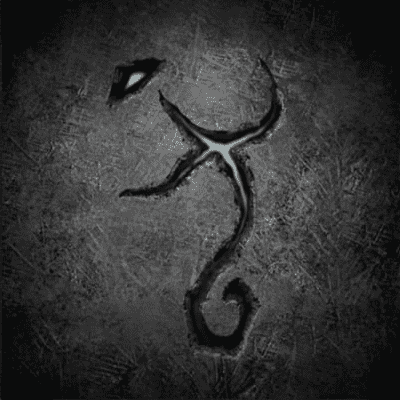
The Guidance rune depicts a figure with a detached head, following an ethereal light. While many interpret this as purely symbolic—representing the act of following guidance even unto death—Ludwig's nightmare form suggests a far more literal interpretation: he beheaded himself with the Holy Moonlight Sword in an act of desperate salvation.
Ludwig's nightmare form is not simply a mutated beast. Close examination reveals two distinct "heads":
This second formation is not merely a malformed head—it is a beheading stump, a wound that never healed, transformed by the nightmare into a mouth-like mass of eyes and hunger.
Ludwig's beasthood didn't manifest primarily in his limbs, as was common with other hunters. His corruption rooted deepest in his mind—the seat of faith, reason, and the guidance he followed.
Traditional hunter rites involved amputation: sever the tainted limb, preserve the whole. But when the affliction sits in the consciousness itself, only one severance remains possible.
In his final moments of clarity, Ludwig recognized what he must do. The Holy Moonlight Sword—whether it existed in its arcane form outside the nightmare or was always a vision only he could see—became his instrument of salvation.
The guidance rune's literal truth: follow the light, even to the blade's edge.
He performed the cut himself. Swift. Merciful. A self-inflicted rite to excise the beast from the man, to preserve his reason by removing the vessel of its corruption.
What the nightmare shows us is not simple mutation but symbolic anatomy:
The nightmare renders his salvation as eternal punishment: two selves, one lucid and one feral, forever bound yet forever divided.
This interpretation connects to multiple symbolic threads:
Ludwig may have always seen the sword's true form—the teal glow in his eyes, the ethereal light threading through his vision—even if others saw only Ludwig's Holy Blade. His proximity to beasthood, his excess insight, allowed him to perceive what others could not.
In the nightmare, where symbols become flesh and visions become real, the Holy Moonlight Sword manifests fully. Whether it existed in this form in waking Yharnam or was always a vision he alone perceived becomes irrelevant: in the moment of severance, it was real enough to cut.
Ludwig succeeded. He preserved his mind, his reason, his guidance. The horse head speaks with clarity about honor, about the light, about whether his actions had meaning.
But the body remembers. The stump hungers. And in the nightmare, both truths exist simultaneously—the knight who found salvation and the beast that could not die.
The most merciful interpretation of Ludwig's fate is also the most horrifying: he got exactly what he sought.
Ludwig became his own surgeon, his own dissection, splitting beast from man with the precision of Byrgenwerth's coldest teachings and the faith of the Church's brightest light.
The guidance was always literal. The rune never lied.
The "Guidance" rune seems to depict a figure with the head being clearly disconnected.